
A Truckee Hardy Azalea
I grew up at ~4000 ft, on the Sierra’s west slope, near the south fork of the American river. I have always loved coming across our native western azalea, Rhododendron occidentale in summer. You almost always smell it before you see it. It is beautiful, extremely fragrant, flexible, and late flowering… but the natural distribution of R. occidentale is overwhelmingly western slope and influenced by Pacific/coastal and moist montane climates.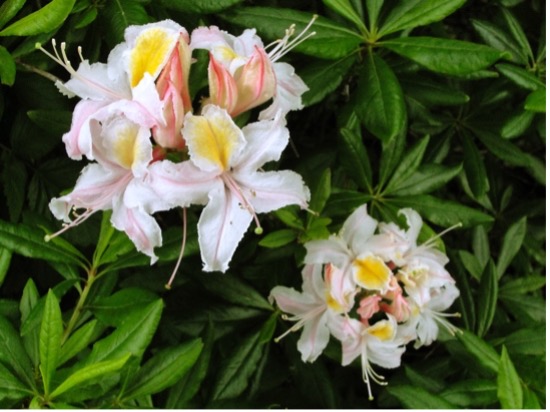
I have seen them near Donner summit, on the west side, and I’m sure they’d do fine at Donner Lake and in the Tahoe Basin (of course), but they struggle to survive the dry-cold of anywhere in the Martis Valley. I have killed quite a few trying. (We do carry them if you have a garden at Donner or Tahoe.)
I have planted many Exbury and other hybrid deciduous azaleas over the years and some persist, but none have really thrived. They usually have their blooms frosted-off in May and many are smaller than they were when planted.
About 15 years ago I found and planted an ‘Irene Koster’, an old Rhododendron occidentale hybrid, a product of the famous Koster nursery in Holland, by crosses between our western native R. occidentale and the Chinese R. molle and R. japonicum (all hardy deciduous azaleas). The group dates to about 1895, although ‘Irene Koster’, selected and named ~ 1915–1919, appeared in American catalogs by spring 1920.
Rhododendton occidentale has a cold-hardiness rating of only about –5°F. ‘Irene Koster’ is supposed to be around –15°F (some say –30°F). It thrives here at the nursery – usually USDA zone 4-ish.
There are three important and separate traits of deciduous azalea involved that are important in Truckee: cold survival, resistance to snow breakage, and bud-flower timing. I would add tolerance to winter sun but deciduous azaleas should be planted in partial shade and protected from freeze-drying winter sun.
Heavy Sierra snow presents shrubs with a different selection pressure than cold hardiness. A shrub can be perfectly hardy at –50°F and still be demolished by ten feet of settling snow.
Heavy snow loads bend stems progressively; if the stems cannot deflect sufficiently, they split or snap. Snow itself offers a thermal benefit by insulating buried plants, but mechanically, it can be devastating.
‘Irene Koster’ yields rather than resist. She makes numerous slender stems (instead of a few stout, rigid branches), that, when buried, arc downward with the snowpack.
Exbury and other hardy azaleas we have grown are brittle shrubs that try to remain upright until the bending moment at every stem or crotch exceeds its strength.
On a compliant shrub the snow load bends the flexible stems until the crown flattens and the load is transferred to the snowpack surface or the ground and so the stems survive and recover in spring.
‘Irene Koster’ is not merely “hardier”. She has a more snow-adapted architecture.
The Western azalea, R. occidentale, contributed enormously to European azalea breeding because it brought a naturally loose branching habit. strong fragrance, large flowers, late flowering, and orange-red autumn color.
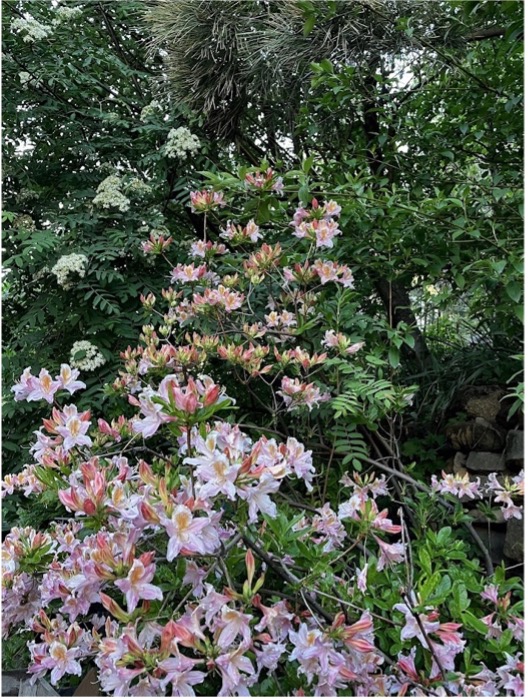 The original Koster Occidentale crosses were described as extraordinarily vigorous with huge fragrant trusses and late-May/June flowering. ‘Irene Koster’ essentially retains a lot of the Western azalea phenotype, “look”, without western azalea’s limitations. She inherited the elegant flower, the perfume, later (after frost) flowering and the much more supple growth character from the Western azalea, R occidentale. The R. molle / R. japonicum side offered up greater cold hardiness, a smaller mature size and a little richer color.
‘Irene Koster’ is consistently classified as late flowering. In Truckee, where winter may end, restart, end again, and then throw a frost while everything is blooming, “late flowering” is valuable.
Marinus Koster established a nursery near Boskoop around 1840. His son Anthony Koster (1843–1941) became one of the major figures in deciduous-azalea breeding.
The Kosters frequently named plants for family members. Irene Arita Koster was Anthony Koster ‘s daughter. Her father named his new fragrant pink azalea for her around the time she came of age. Within a year or two, both the family and the nursery across the Atlantic to New Jersey (1921)… and more than a century later her name survives on one of the most remarkable of the old Occidentale azaleas.
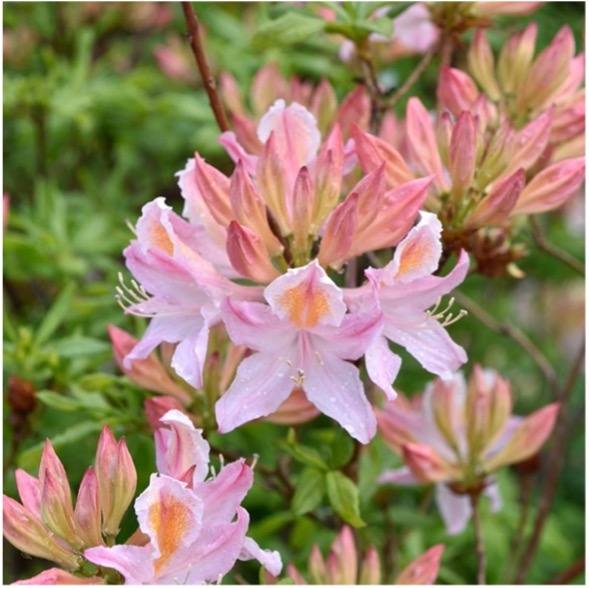 ‘Irene Koster’ wasn’t originally distributed as a single clone. It was originally distributed as seedlings with the genetic variation that comes with any cross. We are lucky to have the strain that performs exceptionally well here.
Eastern Nurseries, Inc., Holliston, Massachusetts, Spring 1920 price list has ‘Irene Koster’ in it. The scanned catalog page reads: “Occidentalis var. Irene Koster, newest Koster Hybrid, clear peach pink… 12–18″ $5 E.”

Eric Larusson
Villager Nursery
Truckee, CA
08/01/2026
(We just received #2 ‘Irene Koster’ – the 3rd time I’ve been able to find them the nursery in the past 20 years. The price may have changes since 1920 but they are about 18″ tall, full, and lovely.)
| Characteristic | Western azalea R. occidentale | ‘Irene Koster’ | Typical Knap Hill / Exbury |
| Genetic background | Western North American species | Occidentale × mollis/japonicum-type hybrid | Very complex, perhaps 8–10 species |
| Conservative published hardiness | about –5°F | approx.. –15°F to -30ºF | commonly Zone 5-ish, cultivar dependent |
| Branch habit | loose, slender twigged | dense/broad, relatively fine branched | often vigorous, upright/open |
| Flowering | late | late-midseason to late | many considerably earlier |
| Fragrance | strong | very strong | highly variable |
| Heavy-snow behavior | flexible but cold limit can be a problem | apparently exceptional where the right strain is grown | often quite rigid/coarse as mature plants |
| Flower color | mostly white/pale pink | pale luminous pink/white + yellow-orange blotch | selected heavily for intense yellows/oranges/reds |