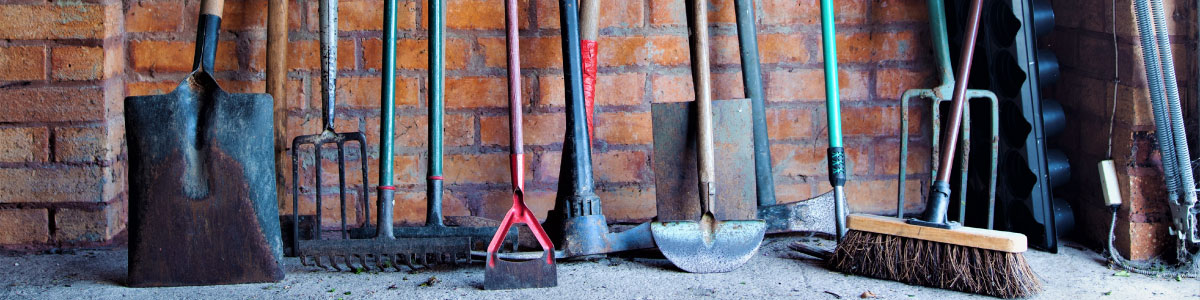
“In our rocky soils the pick side of the pick mattock is great for penetrating and loosening the groutlike silt between the rocks and the lever of the handle easily pops out the rocks” -e
A Few Favorite Tools
While the gardening catalogs and magazines are plugging and peddling new tools and products there are seldom any of Emerson’s proverbial “better mousetraps. Perfectly functional, beautiful and simple tools rest in our garages and sheds already. Here ar my “desert island” gardening tools.
Pick Mattock (1.5lb, 2.5lb, 5lb.) – There is confusion about the names of various kinds of picks. A pick or pickaxe is a short (3-4 ft), heavy handled tool with a narrow sharp pick on one side and, usually, a less sharp and slightly flattened pick on the other – picture Yosemite Sam.
A pick mattock has a pick on one side and a wide hoe-like blade, perpendicular to the handle, on the other. The broadbladed end is essentially an adze. In our rocky soils the pick side is great for penetrating and loosening the grout-like silt between the rocks. For most planting holes, the pick side does most of the work. I swing and drive the pick into the ground, pry it up, pop loose some rocks, and repeat several times. Then the hoe side (or occasionally a shovel) can be used to pull the rocks and soil out of the hole. For large holes I use the large tool, for smaller holes…
Probably my favorite and most versatile tool is my 1.5 Lb pick mattock. My first one was a World War II GI Tool called an “M1910-Pick Mattock” and it has the “U.S.” stamp in the side. A good friend made me an extra long handle (24”) out of Osage orange wood. I have planted #1 to #5 gallon plants with it; it is my favorite bulb planting tool; it is wonderful for 4 inch perennials and annuals as well. I use it to weed in tough soils along the road and I use it to trench for drip tubing in beds. I’ve also used it for botanizing when Mother Nature was hell-bent on using me as a plant dispersal agent. After years of searching we finally found an excellent source for these.
If I’m on my knees gardening, I use the 1.5 lb pick mattick. If I’m digging several wide holes for bulbs or several #5 g. tree / shrub holes then I use a 2.5lb pick mattock. For any hole larger than a #5 pot, I’ll use the 5lb tool.
Bypass Hand Pruners – Bypass pruners cut plant tissues the way scissors cut paper. The wounds are clean and seal quickly in a healthy plant. Always keep the blade side of the pruner toward the tissue you intend to keep. Anvil pruners, by comparison, cut like a splitting maul. The plant tissue is pinched between the blade and a flat anvil, and tissues are usually pretty thrashed.
I had a long relationship with a pair of Felco No.2. The blades are durable and easy to replace. I only replaced mine twice in 25 years. We have been using Zenport QZ bypass pruners for over 10 years now and they have proven every bit as reliable and useful as my Felco’s but at 1/3 the price. I have actually gone down a size, to the QZ_406, in the hand pruners I regularly use because I’ll tend to cut material too large for the 1 of 2 9/9/24 Normal intended range when I should be using loppers. I do use long handled loppers (also Zenport) much more frequently for cuts larger than a half inch, as I should.
Another really useful pruning tool is Japanese tooth patterns hand-saw. Corona makes a little saw with their “Razor Tooth” pattern that really cuts well. And Zenport makes several sizes that are useful and long-lasting.
A spading fork or garden fork is essential for aerating and turning vegetable garden soil in our rock-ridden environment. Spading forks are different than pitch forks. Pitch forks have long handles, and long narrow tines and they are designed for tossing straw. Spading forks are built for digging. They usually have a short handle with a “D” end and 4 or 5 very stout tines.
I use mine to aerate compacted parts of the lawn by pressing the fork 6-8 inches into the soil and then prying back, lifting, the soil an inch or two. Then I move back 4-6 inches and do it again. I’ll aerate whole regions of the lawn this way and it allows for better moisture penetration and gas exchange for the roots. If you have areas of the lawn that grey-out in late summer, try this in those spots before rebuilding your sprinkler system. By the way, one of the silliest tools out there are the shoes with nails on the bottom for “aerating”. Imagine sticking a nail into a block of wet clay; as soon as the nail is out, the hole seals back up.
The spading fork is used to dig the garden beds in the spring and in raw earth it works like a slotted spoon to remove larger rocks while leaving the soil. I have also used mine to toss pine needles, or to hold a pile of prunings and needles in the wheelbarrow while moving it.
There are obviously other tools I like having. I occasionally use a shovel (especially a snow shovel). I love a well-built leaf-rake for pulling pine needles out of beds and the lawn. The backside is great for smoothing mulch. The older I get the more I appreciate my wheelbarrow, an excellent application of several simple machines (wheel, lever and inclined plane). And my Swiss Army Knife is used frequently in the garden to cut twine, pop dandelions out of the lawn while mowing and, toward the end of the day, to open a cold one before surveying the day’s work.