
Fall Planting / Autumn Gardening
Be ready to enjoy gardening as the snow melts. September and October are months to accomplish many of the most important gardening tasks before another long winter settles in. Much of next year’s garden success depends upon the care your garden is given now. Gardening is always about “next year”. The closer we get to winter the less we have to wait until next spring. Look over this year’s garden; note successes to continue and disappointments to avoid. Autumn gardening can be loosely divided into two overlapping types of activity:
(1) Preparing for next spring by planting, dividing, and transplanting (trees, shrubs, perennials and bulbs) and by fertilizing, mulching, preparing soil, and creating new beds. In Autumn we are also trying to extend the growing season.
(2) Preparing for winter by final harvesting, cleaning-up, cutting-back, staking, tying and putting away tools, etc…(“winterizing” a later class).
Watering – In your established garden, cut back on watering now if you haven’t already. Constant water late in the season delays acclimation in many plants and makes them more susceptible to dieback in the cold (new plantings do require a little more water). Once leaves begin to turn color and drop it is good to increase watering a little. Soil moisture is essential for expansive fall root growth. Water new plantings at least once a month after October unless they receive plentiful snow or rain. Use Thanksgiving as a reminder to send your garden into winter deeply watered. If no snow is present by Christmas, hand water new plantings again (“once a month all winter if there is no deep snow”).
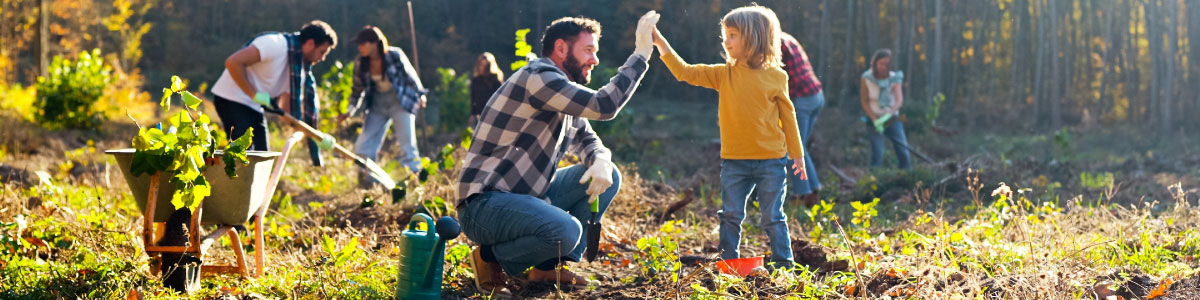
“Fall is for Planting!” Many trees, shrubs and perennials will do as much as 80% of their annual root system expansion, in fall, after they lose their leaves.
Our soils are accumulating warmth until some time in November (soils are still getting warmer). Anyone who has ever grown vegetable seeds indoors knows the importance of soil warmth and the tremendous difference it makes in promoting root growth. Without foliage demanding constant moisture (because of cooler temperatures, shorter days, cessation of top growth, or lack of leaves) most of the plant’s energy is dedicated to expanding roots. Sugars and other nutrients are transported into the roots. Water floods into the cells. The result is rapid expansion of the entire root system. Fall-planted trees, shrubs, and perennials will have expanding root systems better able to utilize spring snowmelt long before any of us begin any spring planting.
We are always planting perennials for the future. Perennials planted this fall will bloom in their appropriate time and expand throughout next summer. Perennials planted next summer won’t really settle-in until the following spring.
Divide perennials now, while the soil is warm; bleeding heart, daylily, monkshood, Phlox, Siberian iris, peony and more may be dug up and cut or pulled apart and replanted. Give each division the same soil preparation, slow releasing organic Biosol fertilizer, compost, and mulch as you would any new plant. Water well.
Transplanting is easy in perennial gardens. If a plant doesn’t grow or bloom well in one location, move it. Fall is a good time to move perennials to a better location. Trees and shrubs that were planted in the past 3 years can usually be moved safely as well when you start to see fall colors.
Lilac, aspen, chokecherry, thimbleberry, some willows, and spiraea produce sprouts or ramets from shallow lateral roots that can be divided from the main plant. When their leaves are showing fall color they should be dug up with as much root as possible. Make a clean cut on the main lateral root, replant as you would a new tree or shrub taking care not to plant the new division too deep.
Cuttings – Cuttings are an easy way to propagate many shrubs. Cotoneaster, Lonicera, Ribes, Rosa, Salix, Spiraea, Viburnum are all genera that grow easily from cuttings. Cuttings should be from canes grown during the current season at least a pencil’s thickness in diameter. Trim the bottom of the cutting just below a leaf node and just above one at the top (8-18” long). Dip the bottom of the cutting into a rooting hormone. Make a propagation trench in an out-of-the-way, slightly shady spot in your garden (or use a portion of a raised bed). Refill the trench with loose, rich potting soil. Stick the cuttings about 5 inches apart into the soil with 2-3 buds above ground. Transplant the rooted cuttings next summer.
Bulbs – Bulbs should be planted now and anytime before the soil freezes solid (~Dec.)… we’ve continued to plant bulbs well into January in some warm years. Plant with a great bulb fertilizer like Biosol, fish bone meal, or rock phosphate. Plant into rich, well draining soil. To achieve the greatest effect, plant single varieties of bulbs en masse. You can put several types of bulbs in the same large planting hole. Protect tulips from squirrels with wire mesh, bitrex PlantSaver, plantskydd, or by planting with narcissus or even garlic. Bulbs are some of the best additions to “wildflower” gardens.
Collecting Seed – Many native and cultivated plants are producing seed right now. In most cases, the seedpods must be opening and the seed nearly ripe before they can be harvested (flowers do not have seeds, they make them later). Easy seeds to harvest: poppy, Cosmos, Lychnis, columbine, Delphinium, Aster, hollyhock, Penstemon, lily, wild rose, currant, gooseberry, mt. ash, thimbleberry, dogwood, snowberry, Jeffrey pine, lodgepole pine, fir, etc… Create a “seed bed” in a partial shade location with a loose “peat-light” (peat moss, perlite, vermiculite) amended soil.
Wildflower planting: Hydroseeding is referred to as “spray and pray” but this greatly increases odds of success. Ask us.
Organic fertilizers like the G&B and Biosol, applied in the fall, slowly break down with the biological activity of your soil. They release small amounts of nutrients during fall root growth and are readily available in the early spring under the snow when roots begin growing again. They’ll continue to be available when top growth is resumed. Most chemical fertilizers will leach away through the soil over winter, wasting nutrients, depriving plants, and polluting. Always add slow release organic fertilizer when planting any time of the year. Avoid liquid chemical fertilizers in Fall.
Mulch is loose compost spread thickly, 3-5”, and broadly on top of the soil surface, out from plantings to preserve soil moisture and improve the soil health. As mulch breaks-down over the winters, by fungal activity, the humus works into the soil. The majority of organic decomposition in our region occurs under snow by fungi. The longer the winter, the more the carbon and nutrients are cycled back into the ground.
All of your plants should have fresh mulch added at planting time and maintained thereafter. Protecting and feeding your soil will make your garden’s care much easier.
Winter mulches of mature compost (Gromulch or FirMulch) or of raw wood chips can be spread in late fall over freezing or frozen soil in order to help keep the soil frozen. This protects plants from the destructive effects of repeated freeze / thaw cycles that can ruin roots or lift plants out of the ground by the “heaving” of the soil. In the case of hardy bulbs, late mulching over the frozen crust helps keep rodents from burrowing.
Most plants will benefit from a layer of mulch over their generally shallow roots to shade them from our winter sun and prevent desiccation in our very drying climate. Pine needles or fir boughs may be lightly placed over perennials with exposed crowns or late basil rosettes of leaves (peony, Oriental poppy, lupine, foxglove). This is unnecessary when many feet of snow cover the ground but we never know when that will be.
Occasionally mulches may be used to keep the soil in a bed unfrozen for a little longer so that certain bulbs (Iris) may be planted after the normal planting season is over.
Lawns – Lawn care for homeowners has always been a little different than it is for golf courses. Even with the best soil preparation, the rich organics we add to our soils eventually break down and need to be replenished. Top-dress at least once a year (with Topper) use organic fertilizers ( Biosol and G&B Lawn) and use a mulching mower so the beneficial microorganisms have something to turn into compost. The use of bioactive, organic fertilizers both feeds and inoculates the soil in order to maintain a healthy soil ecosystem.
If you have sod, you should be aerating your lawn twice a year for the first 3-5 years and once every year (or two) after that. Sod from Nevada is produced in alkaline sandy clay that compresses with traffic. It can suffocate roots and inhibit water infiltration. Aerating twice a year makes thousands of holes through the clay that fill with Topper and organic fertilizers and allow for air and water to get to roots. Top dressing is essential and aerating is recommended for seeded lawns as well. Thatching is seldom necessary.
Pruning – Avoid pruning in fall or winter. Physiologically, the best time for major pruning is in late winter and then throughout summer. Fall pruning is like cutting off your hand in fall and having to wait until spring until it even begins to heal. Our long, cold, dry winters are very harsh on fall pruning cuts.
Extending the growing season – Floating row cover: frost fabric, old Christmas lights, seaweed.
Autumnal Thermal Overturn – In fall (usually late November) the average air temperature becomes colder than the average ground temperature. Ecologically, this is the “autumnal thermal overturn”. Until that time our soils are, statistically, accumulating heat, and at that time soils BEGIN to slowly cool. Plants require warm soil and moisture to maximize root growth. Combined with cooler air temps, shorter days and a little moisture, late summer and fall are a perfect time for planting.
Houseplants – Bring Begonias, Impatiens, Ivy and Zonal Geraniums inside before hard frosts (or is it too late already?) – Spray them with insecticidal soap and / or Neem first, to knock down any potential insect pests.
Fall is a good time to transplant houseplants while you can still do it outside; it can be a messy job in the house. Make sure the potting soil is warm before you transplant. It is a great idea to take all your houseplants outside for a wash with insecticidal soap and a plant polish with Neem or Superior Oil (which also kills insects and their eggs) before winter.