
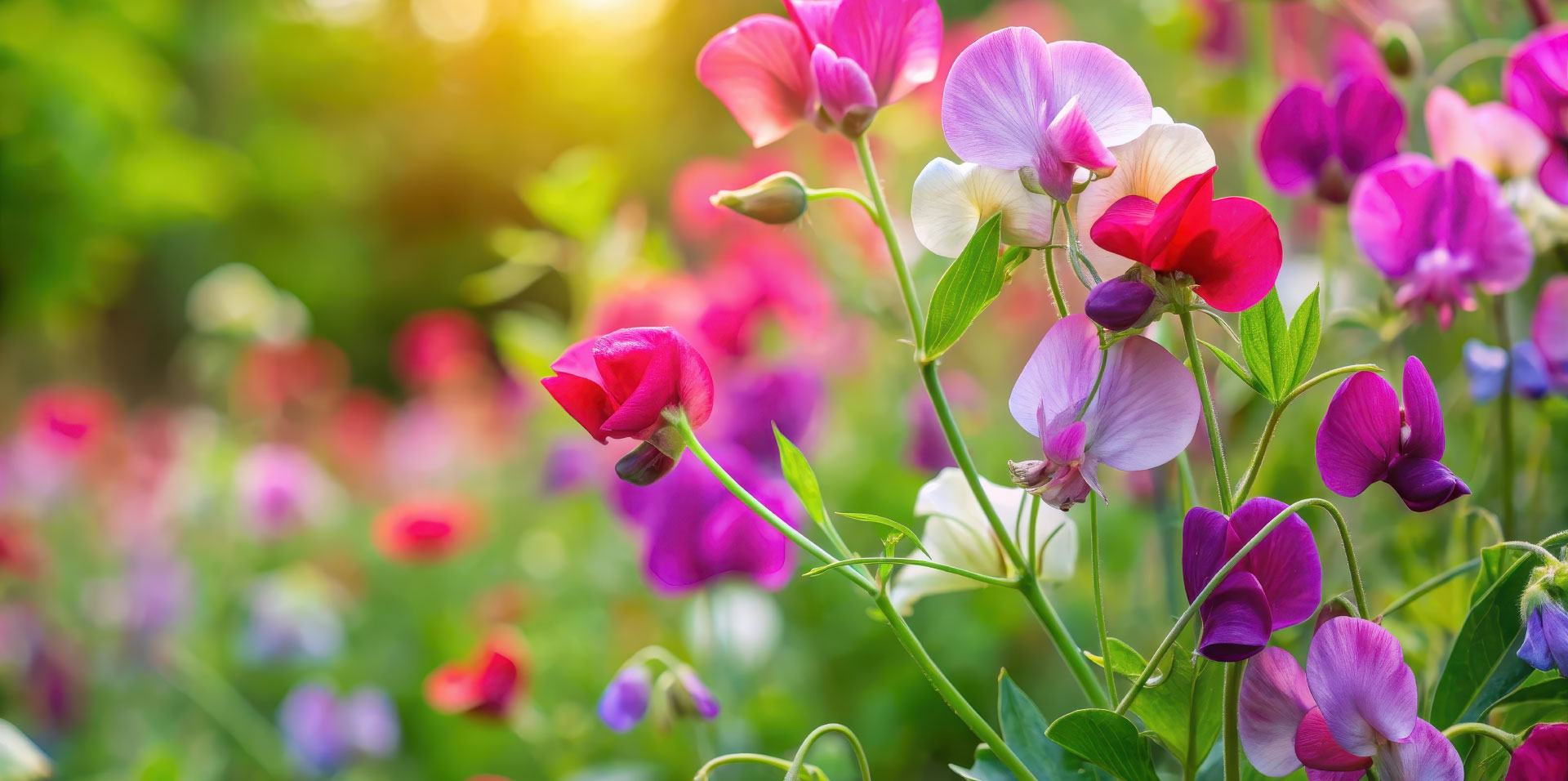
Planting Instructions
Sweet peas prefer a sunny location with rich, deeply worked, sweet (not sour acid) soil.
Prepare your soil by placing farmyard manure at the bottom of a 8-10” trench. Cover with a mixture of soil, Kellogg’s Amend, plus a little Biosol and G&B Veggie food (nutrients and inoculant). Dolomite or other lime helps most legumes in our soils. Consider covering the row with black plastic for several days to warm the soil prior to planting.
By Seed
in late March… (or when you can)… Prepare your seeds by soaking them for 12-24 hours in water (change the water a few times for better germination). Space the soaked seeds onto a moist paper towel. Put the seeds and paper towel in a plastic bag atop the hot water heater or in any warm dark location. Leave for 3 days, then check daily for germination.
When most of the seeds have just the beginnings of root tips showing, it is time to plant them in pots or outdoors (the traditional planting day in Truckee is April 1). VERY Carefully, place the sprouted seeds 1 1/2” deep – Do not break nor even touch the roots. Only cover the sprouted seeds with 1/2 inch of soil. Let the rest of the soil fill in over time as the plants grow.
From Pots
in early May… (or when you can)… Carefully remove the rooted seedling and soil from the pot and plant with the top of the soil 2” below the soil line. Don’t fill the hole, let soil fill in over time.
Pinch off the tip of your sweet peas in May, when they reach 6 inches tall with at least 3 healthy leaves (this will produce stronger, bushier plants).
Other Related Species
Everlasting Pea or Perennial Sweet Pea (Lathyrus latifolius) is a relative of L. odoratus, but is an invasive European perennial vine with attractive sweet pea flowers lacking any scent. They work well in a harsh site, far from the rest of your garden.
Spring Vetchling or Spring Pea (Lathyrus vernus) is a rare, delicate, and attractive woodland perennial, native to forests of Siberia.