
 Peony (Paeonia species)
There are between 30 and 40 species within the Paeonia genus from Europe, through Asia and western North America. California hosts the only two North American species. There are over 7000 accepted cultivated varieties, hybrids and selections.
The Garden Peony, Paeonia lactiflora, from Asia (Tibet to Siberia) is also known as Chinese Peony. This species has been in cultivation in Chinese gardens since the 6th century and was introduced to European horticulturists in the late 1700’s where its amazing size and color was highly prized. European settlers started bringing ornamental peonies with them to the US in the 1830’s and by the 1850’s American nurseries were offering them for sale. Settlers moving west brought peonies with them and planted them wherever they stayed. The plant is relatively easy to divide and to share with friends and one plant can live to 100 years or more! Peonies are extremely hardy and are almost never damaged by hard late frosts in Truckee. Many of the showiest cultivars need “peony cages” put over them in early spring to provide support when the heavy grapefruit-sized double blooms later develop and open.
The native European Paeonia officinalis is an attractive plant that blooms in Truckee gardens mid-late May. Villager nursery has plants of this species propagated from seed collected from long-time Truckee grown plants. The Japanese peonies, Paeonia x suffruticosa., are relatively cold-hardy woody plants that need to be wrapped and well protected in winters. The flowers are almost twice the size of Chinese / garden peonies. They are challenging to grow in Truckee but do well in the milder climate of the Lake Tahoe basin and around Donner Lake.
The ITOH Peonies are intersectional hybrids of Chinese and Japanese peonies. Attempts were made to cross these species for centuries without success until in the 1940’s. Toichi Itoh spent decades of his life developing just a small handful of amazing varieties. The ITOH peonies are herbaceous, dying to the ground each winter but rising to produce enormous and colorful blooms each summer. The ITOH peonies also perform better in the milder microclimates near the lakes.
Planting, Growing, and Caring for Peonies
Peonies are long-lived cold-perennials. They return and grow larger in Truckee and Tahoe gardens for decades and even centuries. Peonies bloom from late spring through early summer, depending on location and variety, and produce magnificent cut flowers. Peonies are hardy to USDA zone 3. Provide full sun and well-drained soil.
Peonies love cold winters and need the cold for healthy bud formation. AND deer almost never bother peonies!
Types of Peony Flowers
There are six peony flower types to choose from: anemone, single, Japanese, semi-double, double, and bomb. Fragrances vary as well—some plants, such as ‘Festiva Maxima’ and ‘Duchesse de Nemours’, have intoxicating rose-like scents, while others are lemony or have no scent at all.
Where to Plant Peonies
Peonies can be used to line walkways as a low hedge or as a substitute for boxwood. After the blooming period, when fertilized, peony foliage is attractive, dense, and glossy green unlike many other hardy perennials. The leaves turn purplish and yellow in fall.
In mixed borders, peonies bloom with columbines, baptisias, and veronicas and combine well with irises and roses. Plant white peonies with yellow irises and blue veronicas. Plant pink peonies with blue cat mints or Corsican violets.
PLANTING
Peonies like full sun, though they can survive with half of a day if it is uninterrupted. Peonies produce the most blooms with at least 6 to 8 hours of sunlight.
Peonies’ large blooms can make them somewhat top-heavy so avoid planting them in high wind areas. (Use peony cages to support blooms, if necessary.) Don’t plant too close to trees or shrubs. Peonies aren’t demanding but they don’t like to compete for nutrients, water, and light.
Plant peonies in well-drained, humus-amended, rich, fertile soil. Near neutral soil pH is ideal.
How to Plant Peonies
Space peonies 3 to 4 feet apart to allow for good air circulation between the plants. Still air should be avoided in most garden settings as it promotes fungal diseases .
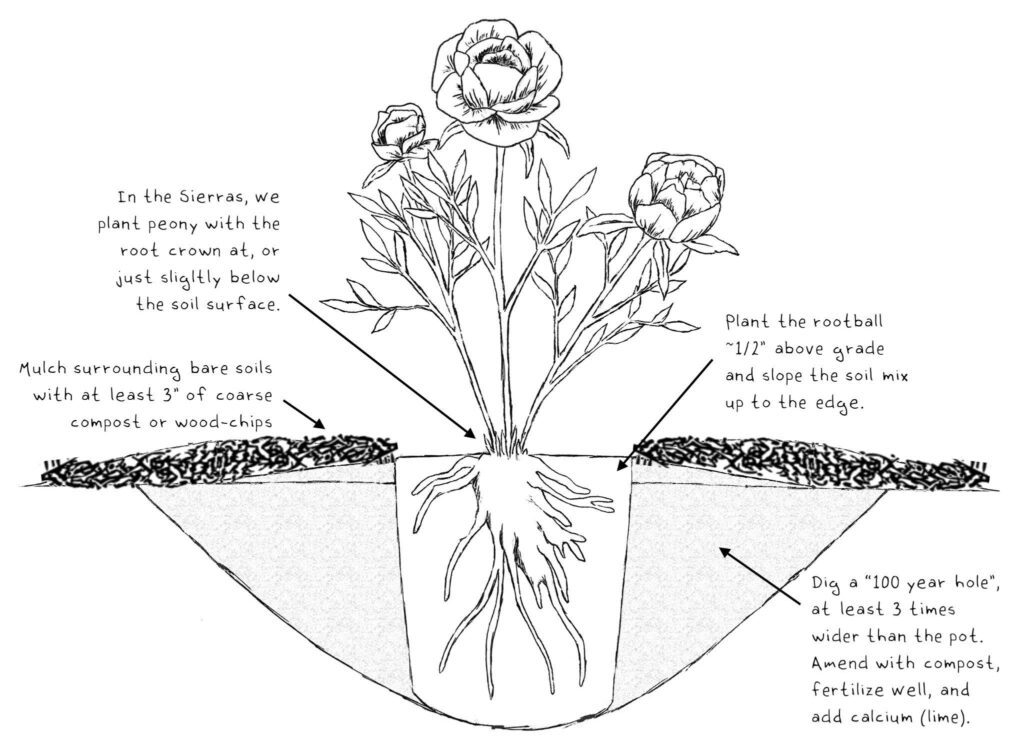
Dig a generous-sized hole, about 1 foot deep and >2 feet across in a well-drained sunny spot. Add mature finished compost (Kellogg’s Amend) to the soil in the planting hole. Incorporate about one cup organic vegetable food or bone meal into the soil mix.
With root divisions, set the root so the eyes face upward on top of a mound of soil in the hole, placing the roots just a half inch below the soil surface. Don’t plant too deep! (In southern states, choose early-blooming varieties, plant them about 1 inch deep, and provide some shade.)
Then, backfill the hole, taking care that the soil doesn’t settle, and bury the root deeper than 2 inches. Tamp the soil gently.
When planting a container-grown peony, cover it no deeper than it grew in the pot.
Water thoroughly at the time of planting.
Peonies, like lilac, Delphinium, and Dianthus, benefit from the addition of limestone to their soils, every now and then. When a peony won’t bloom it is usually because it is planted in too much shade. Secondarily, if the crown of the plant is buried too deep in Sierra gardens; a peony will produce many thin leaves from the crown, often with pea-sized buds that never mature or open. A peony planted just an inch below the soil surface will often never produce mature flowers.
Peony Care
Peonies can take a few years to mature. The old adage “the first year they sleep, the second year they creep, and the third year they leap” applies well to peonies. Peonies do thrive on “benign neglect”. Unlike many perennials, they don’t need to be divided every few years.
Our poor mountain soils lack important nutrients. Fortunately, peonies are not heavy feeders, so fertilize lightly. Spread organic fertilizer broadly to encourage a wide root system. Use Biosol or G&B Vegetable Food, plus compost or aged manure, in early summer just after the peonies have bloomed to keep the foliage looking nice and to maximize nutrient uptake.
Coarse compost or wood chips, 3-5” deep in an 4-5’ diameter around each peony will ensure that the soil’s organic matter is being replenished. Our fine silty, mineral soils will return to their near-concrete like state after just a few seasons without mulch.
Help the stems. If peonies have one detraction it is that their huge blooms are sometimes too heavy for the stems. Three-legged peony cages, rings, or even tomato cages all can work to provide support. It is important to set them up before the peonies begin to grow.
Peonies benefit from the addition of calcium, an element lacking in our local Sierra soils. Calcium helps Peony in myriad ways but improved stem strength may be the most obvious benefit to the gardener.
Deadhead peony blossoms as they begin to fade, cutting to a strong leaf for the best aesthetics.
Dividing Peonies
Peony plants require little maintenance as long as they are planted properly, fertilized lightly and mulched broadly.
While peonies do not NEED to be divided, September is the best time to divide them so you can start more plants and increase the population. Cut the leaves to 5”, then dig around the plant in a wide circle, and lift the soil and root system with a spading fork. Cut the root crown into sections that have no less than 3 to 5 eyes (next year’s buds). Replant the root sections, with eyes just below the soil surface. Lightly mulch new plantings to ensure the crowns do not dry out the first fall and winter.
If you need to transplant a peony, September is the best time, when the foliage has changed color. Ideally, peonies should be settled in the ground for about six weeks before the ground freezes. The “autumnal thermal overturn” is in mid-November in Truckee and usually later in the Tahoe basin.
Peony Winterizing
In late fall, when foliage has turned brown, cut the leaves to about 5” above the ground. The petiole stubs provide a snow-catch and some shade for the crown in low-snow winters.
Don’t smother peony crowns with mulch. For the first winter after planting or dividing, mulch VERY loosely with pine needles or shredded bark. Remove crown mulch in the late winter.
Post-Harvest Physiology (cut-flower peonies)
Peonies make wonderful cut flowers, lasting more than a week in a vase. For best results, cut long stems in the morning when the buds are still fairly tight.
You can wrap freshly cut peony stems and buds in a damp paper towel and put them in a plastic bag in the refrigerator until you’re ready to use them, often months later. When removing the peonies from the refrigerator, give the stems a fresh cut and place them in lukewarm water to wake them up.
Ants on My Peonies
Gardeners wonder why ants crawl on the peony buds. They are just attracted to the peony’s sugary exudates on the buds. Energy efficiency is an evolutionary driving force and plants seldom “waste” energy like sugars. It is thought that having ants eat the sugary droplets may help loosen the tight sepals around the peony buds or that the ants will protect the buds from harmful pests. Do not spray the ants; they are in no way harmful and are likely helping the peonies.
Peony (Paeonia species) History
There are between 30 and 40 species within the Paeonia genus from Europe, through Asia and western North America. California hosts the only two North American species. There are over 7000 accepted cultivated varieties, hybrids and selections. Quite a selection over many years.
The Garden Peony, Paeonia lactiflora, from Asia (Tibet to Siberia) is also known as Chinese Peony. This species has been in cultivation in Chinese gardens since the 6th century and was introduced to European horticulturists in the late 1700’s where its amazing size and color was highly prized. European settlers started bringing ornamental peonies with them to the US in the 1830’s and by the 1850’s American nurseries were oering them for sale. Settlers moving west brought peonies with them wherever they stayed.
The native European Paeonia officinalis is an attractive plant that blooms in Truckee gardens mid-late May. Villager nursery has plants of this species propagated from seed collected from long-time Truckee grown plants.
Japanese peonies and the ITOH peonies are challenging to grow in Truckee but do well in the milder climate of the Lake Tahoe basin and around Donner Lake. The Japanese peonies, Paeonia x suffruticosa., are relatively cold-hardy woody plants that need to be wrapped and well protected in winters. The owers are almost twice the size of Chinese garden peonies. The ITOH Peonies are intersectional hybrids of Chinese and Japanese peonies. Attempts were made to cross these species for centuries without success until in the 1940’s. Toichi Itoh spent decades of his life developing just a small handful of amazing varieties. The ITOH peonies are herbaceous, dying to the ground each winter but rising to produce enormous and colorful blooms each summer.