
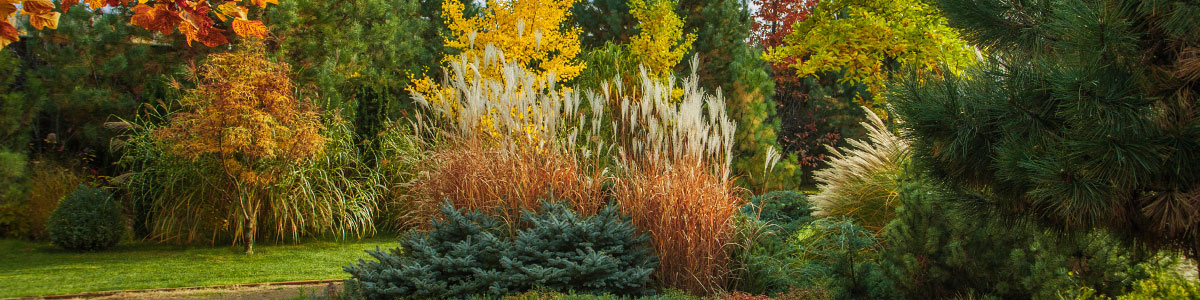
Fall Color in Your Garden “Autumn is a second spring when every leaf is a flower.” – Albert Camus
Fall colors include foliage, stems, fruits and still a few flowers. There are beautiful perennials and annuals which will continue to give us colorful blooms for many more weeks. Some bulbs, like autumn crocus, are fall blooming. Fall foliage colors are plants’ displays that begin with the ending of summer. In autumn the sun drops lower in the sky every day. Traveling through more atmosphere, red, orange and yellow are more prominent components of the sunlight we see. We’re surrounded by tones of yellow, orange, pink, peach, rust and red from the plants as well. Plants like dogwood and river birch produce nearly purple leaves each fall.
The Biology of Fall Color
Chlorophyll is the green of plants and it is the main pigment responsible for photosynthesis (light energy and CO2 to chemical energy). As days shorten, nights cool and plants dry, photosynthesis decreases and spent chlorophyll is not replaced. As the green of chlorophyll fades, other pigments that were previously masked begin to show. Carotinoids, tannins and anthocyanins are some of the other major pigments found in deciduous leaves.
All leaves contain carotenoids that help transfer light energy to chlorophyll. There is a reason so many of our high-elevation plants have a golden fall color. Carotenoids help protect chlorophyll from high-elevation overexposure to light. Beta-Carotene is one of the most common carotenoids present in most leaves. Beta-Carotene absorbs blue and green light and reflects yellow and red light, giving leaves their orange hues.
Carotenoids are more durable than chlorophyll but less efficient at light gathering. They help by protecting the fragile and more efficient chlorophylls. Carotenoids are bound in the chlorophyll containment areas of each leaf cell.
Flavonols, a part of the flavonoid protein family, is always present in leaves. Though present, it’s golden colors remain unseen until Chlorophyll production slows.
Anthocyanins are water soluble (“watercolor”) pigments dissolved inside leaf cells. Anthocyanins produce red, pink, purple and blue colors. They are the pigments found in purple-leaved trees & shrubs. The early red color of new growth in many high-elevation plants is from anthocyanin; it blocks some UV light and the sugars act as anti-freeze. Anthocyanin production increases as chlorophyll production declines.
Anthocyanins make cherries, cranberries, and beets red and make grapes and blueberries blue. The inside of cells become more acidic with age and lower pH makes anthocyanin colors more red. Early season cell contents are more basic and will generate more blue colors from the same anthocyanins. Iron and aluminum in leaf cells also modify colors. Anthocyanins are used as pH indicators because their color changes with pH; they are pink in acidic solutions (pH < 7), purple in neutral solutions (pH ~ 7), greenish-yellow in alkaline solutions (pH > 7).
In cells, anthocyanins are “blue blockers” and filter-out damaging ultra-violet (UV) light.
Anthocyanins are fused into sugar molecules within cells and sugar supplies are required for anthocyanin production and display. As leaf sugars are generated for transport out of the leaf (for storage in roots and stems), low temperatures and a developing abscission layer slow sugar movement and keep more in the aging leaves.
In plants with red fall colors, more sunlight usually produces better colors. Vine maple, big-tooth maple, mountain ash, serviceberry and red-twig dogwood all grow well in moderate shade and still give us intense orange-red through purple fall colors. Orange leaves are a combination of anthocyanins and carotenoids.
When chlorophyll, carotenoids and anthocyanin are gone and the leaf turns brown, tannin is responsible. Tannin gives us the beige, tan and brown of autumn. Tannin is contained in all leaves in varying amounts. Some trees such as Bur Oak and many grasses have high concentrations of tannin and their leaves turn amber in fall.
Causes of colors:
While the genetics of plants determine which colors the plant can display, there are also other factors. Shortening day-length, cold nights and drought are all factors. We have no control over the first two but we can often affect the third. Drier conditions in late summer can reduce the production of chlorophyll and hasten the transition into winter acclimatization. Ideal conditions for the best fall colors start with a couple of September frosts followed by warm sunny autumn days and cool (barely freezing) nights for a long “Indian Summer”. Without hard frosts some photosynthesis can continue to produce sugars that are used to make anthocyanins. Weather can also ruin fall colors. Hard frosts can turn leaves brown while cloudy or rainy days inhibit the color because of the lack of light and warmth.
A more acidic soil may make redder leaves and a more alkaline soil makes more purplish leaves in some species. To acidify soil, add cottonseed or neemseed meal or a little iron sulfate. To raise the pH of soil and decrease acidity, add lime or wood ashes.
In order to survive winter temperatures, trees slowly close off the tubes that carry water and nutrients to and from the leaves with an abscission layer of cells that form at the base of the leaf stem, protecting the “limbs and body” of the tree. When the abscission layer is complete, water and nutrients no longer flow and the leaf slowly dies and, weekend at the stem, falls gently away.
What you can do:
Begin cutting back on watering in early September to let plants know it is time to prepare for winter. Plants need to “shutter” up top to avoid winter damage. It is not bad to see your plants occasionally wilt a little but do not let them dry out completely. After fall color begins in earnest, keep-up the watering so the fall root growth can be maximized. (It is best to keep newly planted trees, shrubs and perennials moist in fall to maximize new root production.)
Pruning: If leaves are still green, into mid-September, woody plants should have enough time to seal the cuts before the cold / dry winter. Major pruning is best done late winter to early spring with hedging or heading-back during the growing season. Fall pruning, after dormancy, is not recommended unless a branch is in imminent danger of being ripped off by snow (or if a plant is excessively vigorous). Fall pruning leaves open wounds and removes stored energy.
Fall Color to see:
Pear on High st. corner of Spring. Lilac (actually has purple fall color some years) corner of Church and Donner Pass Rd. – (don’t prune lilacs after June), Tansy, Nova-belgii (New York) aster – (add calcium and pinch in June to help stems stand-up). See Juniper, Arctostapylos, Oregon grape, Thimbleberry at Gray’s cabin. The C.B.White House has a red oak. The Eaton House has several Bigtooth Maples. The Library has Vine Maple, Spiraea and Crabapple. The Hospital MOB has a Golden Currant. The Post Office (1984) has Maples: (Red, Norway, Big-tooth, Amur), Serviceberry, Nine-bark, Red-twig Dogwood, Golden currant, Sumac, Russian olive. Alibi has Hawthorne, and Mt. Ash-tree to shrub. Brickletown has cranberry bushes, oak, Bechtel / Brandywine crabapples, apples and more. The sheriff’s office, Truckee Physical Therapy and, of course, Villager Nursery, have some excellent examples of fall colors.
Plants for Fall Color
| Flowering Trees | Height | Desc. | ||
| Malus ioensis cv. | prairie crabapples | 15-20’ | huge leaves, spectacular red fall colors. | |
| Malus species | apples and crabapples | 15-25’ | golden-orange fall colors, winter fruit display | |
| Prunus persica | peach | 10-15’ | no fruit but spring bloom and fall colors | |
| Prunus virginiana cv. | standard-form chokecherry | 15-25’ | intense red-orange-violet fall colors. Fast growing | |
| Aggressive
Deciduous Trees |
||||
| Populus tremua ‘erecta’ | columnar Swedish aspen | 40-60’ | red fall color, dense upright habit | |
| Populus tremuloides | quaking aspen | 40-80’ | golden fall color, white noise (quaking) | |
| Understory Trees, Very Large Shrubs, “Trubs” | ||||
| Acer campestre | hedge maple | 20-40’ | very dense screen with pruning, golden fall color | |
| Acer circinatum | vine maple | 15-25’ | great bark, rainbow of fall colors, part shade | |
| Acer tartaricum ssp. ginnala | Amur maple | 8-15’ | ‘Flame’ is its fall color. tolerates extreme cold | |
| Acer tartaricum | Tartarian maple | 8-15’ | broader leaf and more varied fall colors than Amur. | |
| Acer glabrum | mt. maple | 8-20’ | open, delicate, pale yellow, cream fall color | |
| Acer grandidentatum | Rocky Mt. bigtooth maple | 12-30’ | best as multi-trunk, great fall colors -All colors | |
| Amelanchier species | serviceberry | 6-15’ | species with bright red-orange fall color | |
| Betula occidentalis | western water birch | 15-30’ | copper bark, yellow-maroon fall color | |
| Cornus sericea | red-twig dogwood | 8-15’ | fast growing, shade tol., red fall color and stem | |
| Crataegus species | hawthorne | 8-10’ | some grown as shrubs, like mt. Ash | |
| Malus sargentii (M. sieboldii) | Sargent crabapple | 6-10’ | profusion of bright red fruit in late fall – winter | |
| Prunus padus | birdcherry | 15-30’ | great fall color, massive shrub, very fast growing | |
| Prunus virginiana cv. | chokecherry | 15-30’ | excellent jam, great fall color, massive shrub | |
| Pyrus species | pear | 15-25’ | red fall color very late, needs protected location | |
| Sorbus aucuparia (M.S.) | multi-stem euro. mt. ash | 20-30’ | multi trunk in part shade, flowers, berries, fall color | |
| Sorbus scopulina | western mt. ash | 4-12’ | native, more open than European Mt. Ash | |
| Quercus gambellii | Gambell oak | 10-20’ | “Magic Carpet” fall colors from high elevation Rky’s | |
| Large shrub ~ 5-10’ | ||||
| Aronia melanocarpa | black chokeberry | 4-6’ | deep green leaves, deep red fall color | |
| Physocarpus spp. | ninebark | 3-4’ | dark purple foliage, burnt-orange fall color | |
| Prunus besseyii | western sand cherry | 5-8’ | hardy prairie native – bright fall color | |
| Ribes aureum (R. odoratum) | golden currant | 4-8’ | Yellow blooms, big black fruit, bright red fall color | |
| Rhus aromatica (R. odorata) | skunkbush sumac | 4-8’ | Rainbow of fall colors. looks like poison oak | |
| Rhus typhina | staghorn sumac | 4-6’ | Spreading clumps, RED fall color | |
| Rosa glauca | red-leaf rose | 5-8’ | great purple leaves, bright orange hips | |
| Spiraea douglasii | western spirea | 4-6’ | unique late flower spikes, orange fall colors | |
| Viburnum trilobum (V. opulus) | cranberry bush | 4-8’ | big blooms, great fall colors, bright persistent fruit | |
| Small shrub < 5’ | ||||
| Artemisia tridentata | basin sagebrush | 2-3’ | dry land, silvery native beautiful with fall grasses | |
| Berberis thundbergii | crimson barberry | 2-3’ | spring prune for summer color, ORANGE in fall | |
| Ericameria nauseosa | rabbitbrush | 2-3’ | awesome fall yellow bloom, silver foliage | |
| Euonomous alata ‘compacta’ | dwf. buring bush | 3-4’ | fluorescent magenta fall color – “Burning Bush” | |
| Holodiscus discolor | rock spray | 3-5’ | great native shrub with large white plumes | |
| Berberis aquifolium | Oregon grape | 6”-3’ | part shade; evergreen, bright red fall splashes | |
| Picea abies ‘nidiformis’ | nest Spruce | 1-1.5’ | finer than mugo pine – keeps the garden “alive” | |
| Pinus mugo ‘compacta’ | mugo pine | 2-4’ | like a really dwarf lodgepole pine | |
| Potentilla fruticosa (Diasphora) | bush cinquefoil | 2-4’ | blooms all summer and well into the fall, blooming. | |
| Ribes roezlii | gooseberry | 1-2’ | bright red fall berries and leaves | |
| Rosa rugosa ‘Hansa’ | hansa Tomato rose | 3-5’ | very hardy rose in Truckee. Large red hips in fall | |
| Rosa woodsii | wild rose / wood’s rose | 3-6’ | bold red hips amid orange fall | |
| Spiraea bumalda ‘Goldflame’ | goldflame spiraea | 2-3’ | golden foliage, pink blooms, red fall color | |
| Spiraea splendens var. splendens | Sierra spirea | 1-2’ | beautiful next to granite boulders or ponds, native | |
| Spiraea betulifolia ‘Tor’ | birchleaf spirea | 2-3’ | red-orange fall color, white blooms | |
| Spirea nipponica ‘Snowmound‘ | snowmound spirea | 3-5’ | big easy shrub with a profusion of white in spring | |
| Symphoricarpos spp. | snowberry & coralberry | 2-5’ | rounded blue-grey foliage turns pale-cream in fall | |
| Syringa meyeri | dwarf lilac | 4-5’ | for a small space, deep purple fall color | |
| Vaccinium angustifolium | lowbush blueberry | 2-4’ | excellent fruiting low shrub with magenta fall color | |
| Viburnum opulus ‘Alfredo‘ | compact cranberry bush | 3-4’ | dwarf of the big-one – berries and red fall color | |
| Woody Groundcovers | ||||
| Arctostaphylos uva-ursi | bear-berry manzanita | 2-4” | glossy red berries in fall | |
| Cotoneaster dameri ‘eichholz’ | bear-berry cotoneaster | 4-8” | red berries and spotted intense red fall foliage | |
| Juniperus communis | alpine carpet juniper (native) | 4” – 2’ | native creeping tough juniper purplish fall color | |
| Berberis repens | creeping barberry (OR grape) | 6” – 1’ | bright red on some of the leaves in fall | |
| Symphoricarpos mollis | creeping snowberry | 4-8” | big white berries in the fall | |
| Perennial Fall Blooms | Perennial Fall Foliage Color | |||
| Achillea filipendulina | golden yarrow | Artemisia schmidtiana | silver mound / angel’s hair | |
| Aconitum carmichaelii | autumn monkshood | Bergenia cordifolia | ||
| Alcea rosea | hollyhock | Dicentra spectabilis | showy bleeding heart | |
| Anemone japonica | Japanese anemone | Eryngium gigantea | sea holly | |
| Anemone sylvestris | snowdrop anemone | Fragaria spp. | strawberry | |
| Aster nova-angliae | New England aster | Geranium spp. | hardy geranium | |
| Aster nova-belgii | New York aster | Hosta | funkia, plantain lily | |
| Campanula persicifolia | peachleaf bellflower | Scabiosa fama | scabiosa | |
| Campanula takesimana | Korean bellflower | |||
| Choeone ……. | turtlehead | |||
| Clematis tangutica | goldenbells clematis | |||
| Colchicum | autumn crocus | |||
| Crucus staivus | saffron | |||
| Digitalis purpurea | foxglove | |||
| Echinaceae purpurea | purple coneflower | |||
| Fragaria x ‘Lipstick’ | red flowering strawberry | |||
| Geum chiloense | Chilean geum | |||
| Helianthus tuberosus | Jerusalem artichoke | |||
| Lewisia cotyledon | lewisia | |||
| Liatris spicata | gayfeather | |||
| Lychnis coronaria | rose campion | |||
| Monarda didyma | bee balm | |||
| Nepeta siberica | Siberian catmint | |||
| Oenothera missouriensis | sundrops oenothera | |||
| Phlox paniculata | summer phlox | |||
| Phygelius x rectus | cape fuchsia | |||
| Physostegia virginiana | obedient plant | |||
| Primula x polyantha | english primrose | |||
| Rosa sp. | rugosa and miniature roses (still in full bloom) | |||
| Rudbeckia fulgida | ‘Goldsturm’ (gold storm) rudbeckia | |||
| Rudbeckia hirta | black-eyed Susan | |||
| Rudbeckia laciniata | lace-leaved rudbeckia | |||
| Rudbeckia nitida | ‘Herbstsonne’ (autumn sun) rudbeckia | |||
| Sedum spectabile | autumn joy sedum | |||
| Tanacetum vulgare | tansy | |||
| Epilobium canun | (Zauschneria californica) California fuchsia |
And many, many more!!!!
“I trust in nature for the stable laws of beauty and utility. Spring shall plant and autumn garner to the end of time.” – Robert Browning