Post-Winter Tree & Shrub Revival – Despite the apocalyptic ravages of “Sierra Cement”, rogue plow drivers, and voracious mammals, there is still much that can be done to salvage wrecked plants. We’ll discuss the nuts & bolts (figuratively and literally) of pruning, splints, stakes and masking tape to bring your woody trees and shrubs back from a crushing winter. Lawns, groundcovers and perennials often only need a little TLC to thrive.
Snow Load: “Sierra Cement” is our high moisture content snow. Our beautiful gardens suffer from snow in a variety of ways: a foot of wet sticky snow when they’re just reaching their peak in June, or during a long Indian summer without frost, the trees still flush with leaves, and we received get a foot of wet, heavy snow, or a series of storms dumps light snow day after day, to incredible depths, without settling followed by deep cold and 80% settling, or rotary plows, blasting ice chunks at 80mph, breaking and shredding every plant within their scopes, right at the snow line. In the most damaging winters we receive rain that turns to wet, sticky snow followed by massive accumulations, followed by deep-freeze (to glue it all in place), followed by rain (to saturate the snow and weigh it down), followed by wet, sticky snow, followed by massive accumulations followed by deep-freeze, followed by rain, followed by wet, sticky snow etc… As snow settles, it yanks branches out of the trunk and crushes or bends to breaking, trunks of even the most flexible and snow tolerant trees and shrubs.
Some landscapes, both natural and planted, in the Sierra are a wreck after any winter. The good news, as with all aspects of gardening is that they are plants and they can grow and eventually recover. Remember: there’s always next year. It doesn’t make the plants grow any faster, but that understanding always makes me feel better.
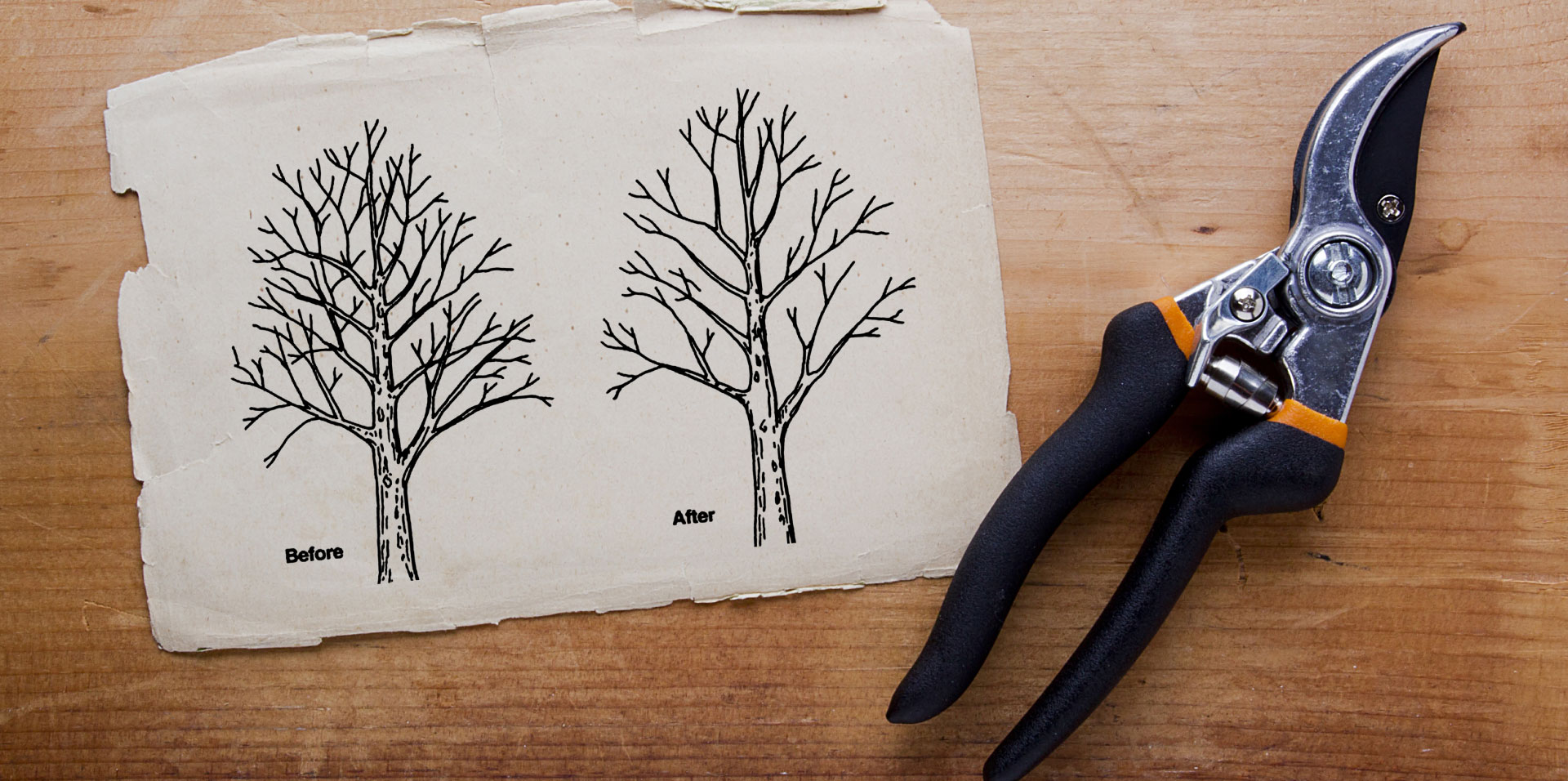
Defensive Pruning: Prune aggressively when plants are young. By heading back your plants in spring and summer for the first few years, you create strong, thick, tapered trunks and short, stout branches with robust shoulders and dense bases that are far less susceptible to the ravages of winter. Wide, weak branches and long, thin leaders are the first to be broken. It is far better for you to cut them than for the snow to rip them. The simple physics of shortening the “lever arms” reduces the forces the snow can exert.
Prune Now: Prune in late winter just before buds begin to swell and again in mid-summer when new growth is at its peak. Prune top and side leaders back to the thickest part of last year’s growth, just above a healthy bud. I use the analogy of preparing asparagus for cooking. With defensive tree pruning, remove the tender part and keep the tough base. This is not “topping”. Topping ruins trees.
Pruning young equates to smaller cuts that seal quickly with less chance of decay. Aspen are especially susceptible to disease and decay and some arborists won’t prune them. We feel that if branches are pruned when small and vigorous, there are seldom any issues.
Our short growing seasons leave us disinclined to remove any gains that our plants have worked so hard to achieve. Prune anyway. If you don’t, the snow may, and storms know nothing of aesthetics.
For a time, there were tree “surgeons” who pruned-out decaying wood and filled holes in trees with cement. Through the lens of tree biology and plant physiology much tree surgery, from the 40’s through the 60’s, was, in-fact, bad for trees.
The ISA (International Society of Arboriculture) Certified Arborists are today’s tree care specialists. Modern arborists are concerned with overall tree health and may advise mulching and fertilizing as often as they will recommend severe cuts. If you have large trees with damage or with potentially hazardous branches, please call a certified arborist for professional advice and assistance (ISA-arbor.com). Think “Safety First”
For small trees like crabapples or maples and shrubs that you can easily reach, there are some very simple methods of pruning and repair that work well. Keep in mind that any drilling creates wounds in the tree that can be potentially harmful and introduce decay.
It is almost always better to remove a severely damaged limb than to repair it. In most cases, a branch that is repaired should be considered temporary.
Physiology of Repair: Between bark and wood (both largely dead materials) of woody trees and shrubs, lies the living cambium layer, a meristem (imagine animal stem-cells) that produces sheets of xylem tissue to the inside and phloem tissue to the outside. Both are vascular tissues. Xylem carries water and nutrients from roots to the leaves and makes up wood. Phloem carries the products of photosynthesis around the plant and back to the roots. Dead phloem becomes bark. A broken branch or trunk must have a significant section of cambium and living vascular tissues in order to survive. If there is at-least one third of the circumference still attached, then there is at least a chance of survival. All of the vascular flow down must travel through the remaining viable tissue.
Pruning excess branches before attempting repairs may be helpful. It is essential that enough photosynthesizing foliage remains to feed growing tissues but if water can’t reach leaves in the first place, the branch will die.
When a branch rips from a tree but appears alive and is still attached by a wide strip of trunk, push the branch back into place and hold it with slings of doubled-up tree-tape. On smaller branches pre-drill holes and use a couple of long decking screws up, across and through the branch into the trunk to secure it. Use bolts and washers for slightly larger branches. Drill in a straight line through the limb and the trunk and connect them using long bolts with wide washers and nuts. An alternative method is to put eye-bolts into the branch and trunk and connect the two with a threaded tension cable and turnbuckle. On straight smaller trunks without the advantage of something to attach them to, I have used a splint: a sturdy piece of pre-drilled hardwood. In time the tree will seal around the metal with many more layers of wood.
Pruning sealer is a tar-like material used, in the past, to cover all pruning cuts. It might still be used to keep thin strips of damaged and surviving tissues from drying out or to deter beetle entry into injured conifers. Pruning sealer actually slows the natural sealing of most cuts, thus, it is no longer used for most general pruning.
To straighten out small trees that have arched-over, tie a rope to an upper portion of the trunk and slowly (over a week or so of warm weather) pull the tree to upright and then past upright to more-or-less, over-correct. This seems to help realign the layers of wood in the trunk. After a few weeks of over-correction, untie the rope. The tree usually returns to some approximation of upright. For conifers with a bent or broken leader (last year’s narrow upright growth): tape a bamboo or redwood stake to the main trunk in two or three locations and leave a foot or so sticking above the tree. Tie either the bent or broken leader to the stake or tie the largest branch from below the broken leader into an upright position against the stake. Use either flexible poly tree-tape or paper masking tape to hold the repairs in place. The tree tape needs to be removed after one year but the masking tape usually decays and falls away on it’s own. The same technique can be used to reestablish a new leader on other trees as well.
If a recently planted young tree has tipped and up-rooted, it should be righted, fed with seaweed and secured in place (guy rope and stakes). If the tree is recently transplanted, the guy will probably only need to remain for a season. If an older tree of a potentially larger species has tipped over, you should seriously consider removing as it’s root support is compromised. If an aspen tips, it is often because of excess top-growth. Heading back the leader and reducing weight in the crown might be prudent.
You will need to stake and wrap your repaired trees and shrubs thoroughly and carefully through the next few winters. It is also very important to keep your trees healthy and to encourage as much root growth as possible. Slow-release organic fertilizers beneath a thick layer of organic mulch will provide long lasting nutrition that encourages quick but sturdy new growth. For transplants and repairs, and for producing stronger plants in general, seaweed extract is an excellent liquid fertilizer for both soil and foliage. The natural plant hormones in seaweed help plants produce new roots, new growth, and stronger cell walls among other benefits.
Don’t forget to water your garden. If your damaged trees are large natives, we have seen amazing results from adding a little organic fertilizer (Biosol with G&B) and supplementing our minimal summer precipitation with a few extra “simulated afternoon thundershowers”.
Coppicing – is the process of cutting shrubs down to near ground level every few years in late winter. The stumps then regenerate during the growing season. The stems might then be removed again. It takes advantage of the natural regenerative properties of many woody species, including willow, alder, dogwood, elderberry, forsythia, shrubby birch, shrubby maple, shrubby oak, or mountain ash. When these species are cut-down, they can rapidly regenerate from the cut stump and produce many new shoots, rather than a single main stem. Coppicing has been practiced since Neolithic times. It is used to produce stems for basket weaving, wattling, or cut flower arranging. It can also be used, post-winter, to regenerate severely damaged specimens.
Check out the urbantree.org Tree Training Cue Card and Villager Tree Winterizing and Garden Winterizing Hand-Outs.
10678 Donner Pass Rd, Truckee, CA 96161-4834
530-587-0771
Find us at villagernursery.com and villagernursery (fb), or villagernursery (i), or villagernursery (t), and info@villagernursery.com…