Mountain Conifer Planting
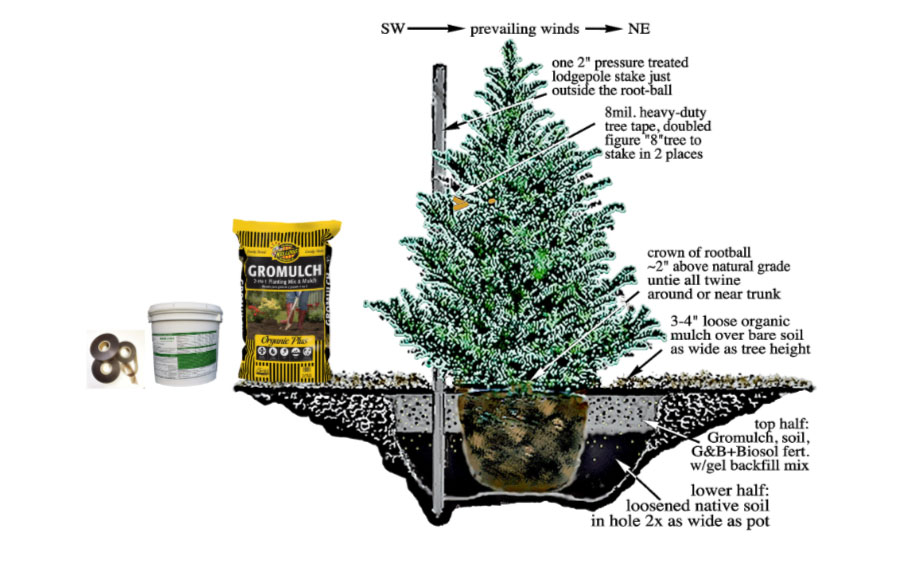
1) In moist (never wet) soil, dig a hole 2-3 times as wide and a few inches shallower than the root-ball of your tree. Trees and shrubs should be planted with the top of the roots (the root-flare of the trunk) slightly above the level of the surrounding soil (above grade). Larger trees should be planted 3-4” above grade. Remove large rocks and store the loosened native soil to one side. 2) Gently slide the root-ball out of the pot and into the hole. Make sure the top of the root-ball is 2″ above the natural grade. Do not disturb the roots of most conifers unless they are extremely dense. IF the root mass appears very dense, it is ok to shave-off a short portion of the periphery of the root-ball (~15% of the circumference, ~1/2” deep off the outer edge – top to bottom) with a knife, hoe, or shovel. Staking may be done now with one (1) sturdy 2” lodgepole stake just outside the root-ball on the southwest side of the tree (support against prevailing winds). 3) Backfill the bottom 1/3 to 1/2 of the hole around the rootball with only loosened native soil. Lightly press; do not stamp or compact the soil. 4) If the tree is B&B (balled in burlap trees are grown and root-pruned in fields, dug-up, wrapped in burlap and set in pots for sale) AFTER carefully placing the rootball in the hole, cut off all twine, string, wire and burlap around or near the trunk. Burlap below the soil line will rapidly decay. Many trees are B&B, then placed in pots. Look for twine at the base of your trees at or above the rootball. Root-control Bags (RC Bags) are used to grow some conifers. Fabric bags must be carefully and completely removed before planting. 5) Continue to backfill with a good soil-compost blend (see below). Using biologically active mature organic composts is beneficial, if not essential. Sierra snowpack recompresses our dense mineral soils that have merely been turned. Composted amendments prevent compaction, enhance aeration and drainage, improve moisture + nutrient retention, support microorganisms, and create a transition from the coarse organic medium of most container-grown plants to our fine textured, poorly structured native mineral soils. Backfill Blend: at least 1/2 native soil mixed with mature, finished composts (Gromulch, manure, etc…), hydrated Hydrosource water gathering gel, and Biosol w/ G&B slow-release fertilizer. 6) Mulch (shade the soil) with 4-5″ of loose compost, bark or wood-chips, from the edge of the original pot to well out past the dripline of the new tree. This is essential. The hard working shallow roots only function well when protected with a blanket of mulch. Rules-of-thumb: NO bare dirt in a diameter at least equal to the height of the tree. Dig the hole three times as wide as the root ball and mulch three times as wide as the hole. Or just “No Bare Soil” (anywhere)! Mulching is absolutely vital and should never be skipped. 7) Water slowly and thoroughly. Newly planted trees and shrubs should be watered 2-3 times per week during the first summer and occasionally well into the fall (approx. the “gallon” size of the pot in water each week, divided into three separate waterings, i.e. one 15 “gallon” tree needs ≥ 3, 5 gallon waterings each week). Even dormant trees need water to survive. Water new plantings at least once a month after October unless they receive plenty of snow or rain. Use Thanksgiving as a reminder to send your garden into winter with very moist soil. If no snow is present by Christmas, hand water new plantings again (and once a month in winter if there is no substantial snowfall). Hydrosource water-gathering gel reduces watering requirements as does adequate mulching. Plants will need less supplemental water each year. The soil, microclimate, and each year’s weather will affect a plant’s chances of survival without irrigation. Even native trees can benefit tremendously from irrigation once a month in summer. 8) Staking with one sturdy 2″ pressure-treated lodgepole stake placed just outside the root-ball of your tree is best (two stakes are used for summer staking in high-wind, not for snowy areas). Tie a double strand of heavy-duty (1″x 8 ml) tree tape from the trunk of the tree to the stake in 2-3 places. This will prevent the B&B root-balls from blowing over before they become anchored.
In extreme snow-load areas an extra bamboo stake may be tied up the center of the tree (i.e. conifers) to splint leaders. Only wrap for the first few winters or until they grow above the settling snow level. 9) Feeding – Along with the essential slow release organic like Biosol fertilizer in the planting mix, acid-loving conifers like spruce and pine benefit from additional spring fertilization with MAXSEA-Acid Plant Food. Once a week feedings in May and June can double or triple normal growth rates. It is equally important to keep the root zone well mulched year-round in order to maintain healthy roots, rich soils, and the fastest growing trees. A late fall application of Biosol will encourage vigorous growth the following spring. Container Christmas Trees – Every year we bring in a beautiful selection of spruce, fir, juniper, and pine for use as living Christmas trees. If you are using your conifer for holiday decoration and later planting, some care must be taken to insure the tree’s survival in a pot, especially over winter. It is important that the roots never dry (summer or winter, in the pot or in the ground). In winter, the greatest threat is a cycle of repeated rapid freezing and thawing of the roots. We recommend that you place your tree on the north or east side of your house for the winter, or dig a hole deep enough to place the entire pot into for winter. |